You might expect an insurance agent to say yes every time someone is ready to enroll. I do not, and I want to tell you why, because it is the clearest way I know to explain what a dedicated agent actually does.
The situation I see all the time
Someone comes to me ready to change plans. Maybe a friend recommended one, maybe they saw an ad, maybe they simply want better benefits. And they are also in the middle of real medical care: recovering from a surgery, going through physical therapy, or working with a team of specialists who already know them.
Here is what most people do not realize. When you move into a new plan, especially an HMO, you may be moving into a new network of doctors and a new approval process. The authorizations your current plan already granted for your therapy or your upcoming procedure do not automatically travel with you. In the middle of care, a plan change can mean:
- Your surgeon or therapist may not be in the new plan's network.
- Treatments that were already approved may need new authorizations from the new plan.
- Care that was underway can be interrupted while paperwork starts over.
For someone mid-recovery, "starting over" is not a small inconvenience. It can set their health back.
The questions I always ask first
Before we ever talk plans, I ask:
- Are you scheduled for any surgery or procedure?
- Are you in the middle of any therapy or treatment right now?
- Is your care being coordinated by a team of specialists?
- Are the doctors you trust contracted with the plan you are considering?
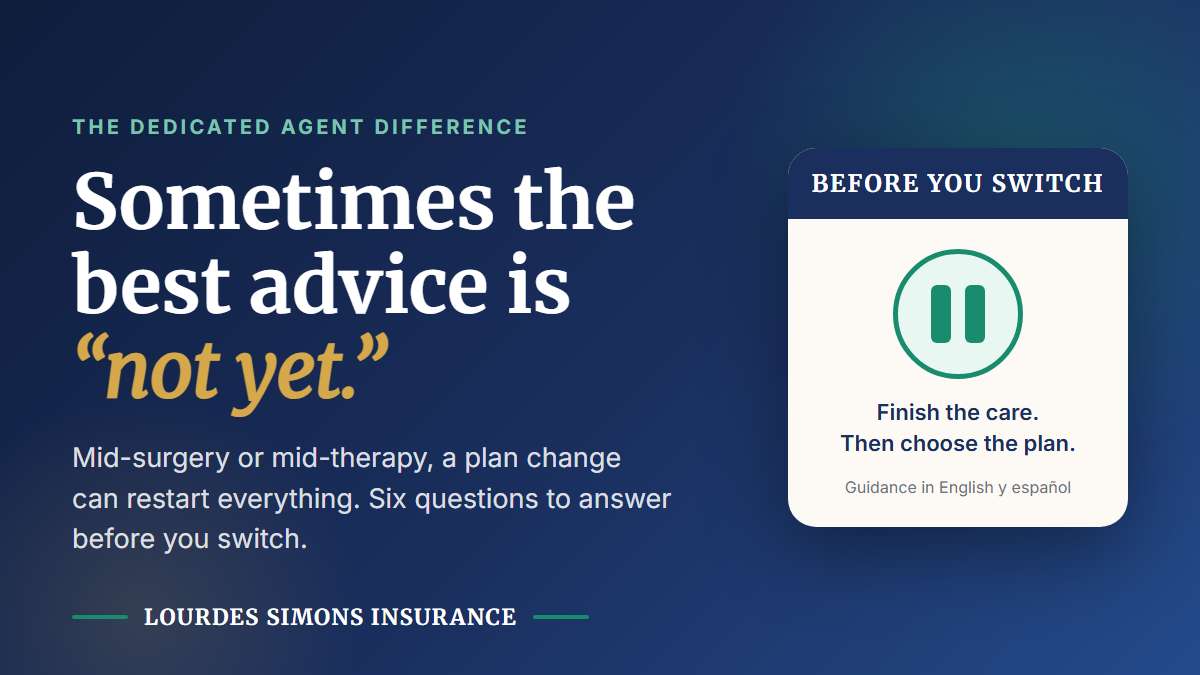
If the answers tell me a change would disrupt care that is going well, my advice is simple: not yet. Let us finish the care first, or wait for the fall enrollment period and see whether one of the new plans covers your specialists. Then we decide with full information.
A real example. I recently spoke with a woman who wanted to move to a new plan. She has had surgeries, she is returning to a medication her doctor wants her on, and her care team is not contracted with the plan she was considering. Enrolling her would have been easy for me. It also would have been wrong for her. So instead, we made a plan: finish this phase of care, review again when open enrollment comes, and see if the new year's plans cover more of her specialists. She did not become a sale that day. She became someone who knows exactly who to call when the time is right.
Why I work this way
Enrollment is the easy part. Anyone with a license can sign you up, and a website can do it without ever asking about your knee surgery. The value of a dedicated agent is judgment: knowing how the programs actually work, what a plan change sets in motion, when the timing helps you, and when it hurts you.
I stay with my clients year after year. That only works if every recommendation I make is the one I would give my own family. Sometimes that recommendation is a new plan. Sometimes it is "your current plan is doing its job, do not touch it." And sometimes it is "not yet, and here is exactly when we will look again."
Six questions to answer before any plan change
- Am I scheduled for surgery, or in active treatment or therapy?
- Are my current authorizations tied to my current plan?
- Are my doctors and specialists in the new plan's network?
- Are my prescriptions on the new plan's drug list, at costs I can live with?
- Do I qualify for a valid enrollment window right now, or am I better served waiting for fall open enrollment?
- What exactly would I gain, and what exactly would I give up?
If you cannot answer all six with confidence, that is not a reason to feel bad. It is a reason to sit down with someone who answers them for a living, at no cost to you, in English or Spanish.
Thinking About a Plan Change?
Let us walk through the six questions together before you decide anything. If staying put is your best move, I will tell you exactly that.
Schedule a No-Cost Consultation